


When is Big Enough?
Sunday 1 April 2013 As the cold hint of another southern winter whistled through Cape Town last week, Spike wonders whether the frenetic treadmill to ride bigger waves will ever end.
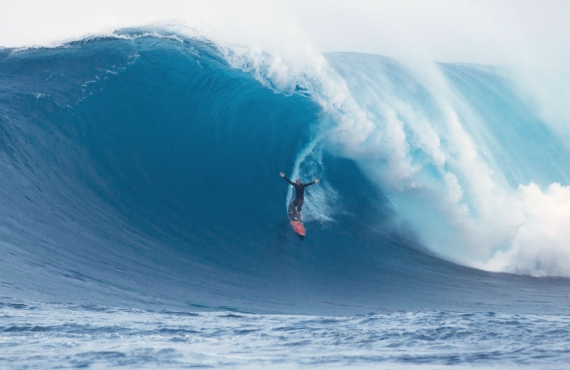
The quest to surf even bigger waves than the monstrosities that have gone before has been put on pause.
Entries are closed for the 2013 Billabong XXL Big Wave Awards until after the winners are announced in California on 3 May, as they enter another northern summer.
Unless technology enables us to ride the ripples from meteorite strikes or other crazy acts of "force majeure", the buck has to stop somewhere.
Sitting in my office in Woodstock, I watched as the front engulfed Robben Island, then swept in across the bay. First the wind-chapped seas, and then the harbour buildings were engulfed in rain and low cloud.
Winter will bring some massive swells. Surfers will tow into some. But maybe like the 100 metre sprint, the record will keep on being broken for another 100 years.
But in terms of physics, the size of wind-created waves does have a limit. They call this process "white capping". As strong winds blow over a long enough 'fetch' and for a long enough time, the remaining factor in wave size is wind speed. When the gale moves towards hurricane force, the vicious tail wind begins to rip the tops off the waves. On top of that, so to speak, the waves are high and therefore steep, so they constantly topple over.
The capping process means the wind can't impart any more energy into the seas, and therefore the waves can't grow higher.
But in the latest press release, the organisers of the XXL awards are up beat about new records tumbling. They are still talking about smashing "down the barriers of what was once thought possible" and of "speculation in the surf media" that one of Shane Dorian or Shawn Dollar's giant paddle sessions at Jaws in Hawaii and the Cortes Bank off California "could potentially exceed" the existing world record for a paddle-in wave set by Dorian in 2011 with a 58 foot wave at Jaws.
The signs are there that while tow surfing has possibly reached its limit, or at least has reached its limit for the time being, the next step in big wave surfing will be paddle waves. Since Chris Bertish became the first guy to paddle surf Jaws a good decade ago, the guys are going back to the purist approach, and are pushing the limits of big wave surfing without the assistance of jet skis.
Interestingly, in the 13 years the XXL awards have been around, 2013 marks the first time that waves caught by arm power alone have been nominated in the biggest wave division. Arm power may yet prevail over the horse power of jetski assist. But whatever thread in the sport evolves faster, there will always be something on the big wave stage that keeps audiences enthralled.
They said the world record for the 100 metre sprint couldn't be bettered. Usain Bolt proved them wrong in the Beijing Olympics (9.69 seconds) and then again at the Berlin World Championships in 2009 (9.58s).
You have to think man can improve on the biggest wave ever ridden, officially recorded by Guinness World Records as Garret McNamara's 78 foot bomb at Nazare in Portugal last November. The units of measurement may seem incrementally more feasible to improve upon, but then so are fractions of a fraction of a second.
But I still draw the line at 100 feet. Surely that cannot be done? However, the biggest observed wave is apparently 112 feet, calculated by an officer on the USS Ramapo in 1933.
And computer models suggest a theoretical maximum of more than 200 feet.
So sky’s the limit, right?
This article appeared in the Weekend Argus, Saturday 30 March 2013
Send adventure news to spike@wavescape.co.za
Spike is the founder of wavescape.co.za
Twitter: Twitter.com/@spike_wavescape
Facebook: WavescapeSA