


Tubular Skies!
Monday 15 June 2015 Ever seen wave patterns in clouds? Chances are it's due to Kelvin-Helmholtz instability: turbulent mixing of two densities caused by velocity shearing at their interface. Say what? Spike explains.
{youtube}bCOg9UASATQ{/youtube}
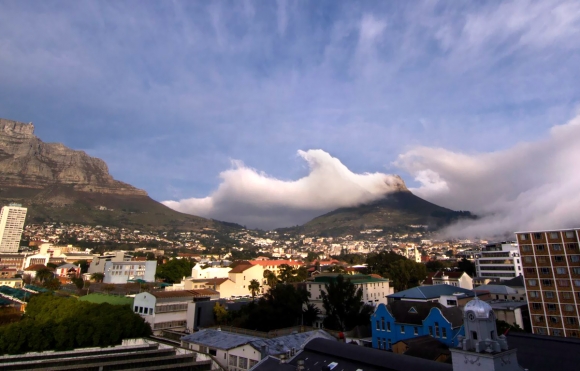
A standing wave over Lions Head, Cape Town.Photo Jonathon Tait(see time lapse above)
A friend of mine posted a screen shot from our Web cam at Kommetjie this morning. It's a remarkable image, with a giant barrel rearing up in the sky somewhere on the way to Brazil.
You will often see recreational posts on social media depicting similar effects in clouds over mountains, ocean or even desert.
These are not signs from the Gods, well they might be. They are not angry entities from disparaged religions venting their cosmic artists' struggle for all the minions upon the planet's face to see. Or maybe there are. Van Hunks is surely not perfecting his smoke ring shapes. You think?
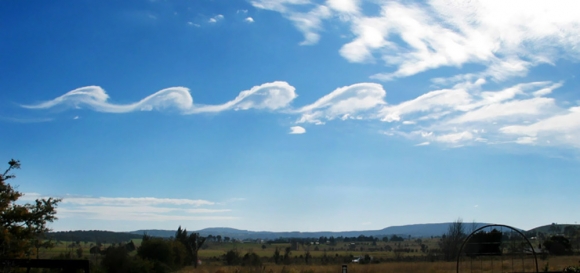
A KH instability rendered visible by clouds over Mount Duval in Australia.Photo Wikipedia
There is a plausibe scientific explanation.
According to Wikipedia: The Kelvin–Helmholtz instability (after Lord Kelvin and Hermann von Helmholtz) can occur when there is velocity shear in a single continuous fluid, or where there is a velocity difference across the interface between two fluids.
An example is wind blowing over water: The instability manifests in waves on the water surface. More generally, clouds, the ocean, Saturn's bands, Jupiter's Red Spot, and the sun's corona show this instability.
The theory predicts the onset of instability and transition to turbulent flow in fluids of different densities moving at various speeds. Helmholtz studied the dynamics of two fluids of different densities when a small disturbance, such as a wave, was introduced at the boundary connecting the fluids.
Understand? Good! See more at Wikipedia here
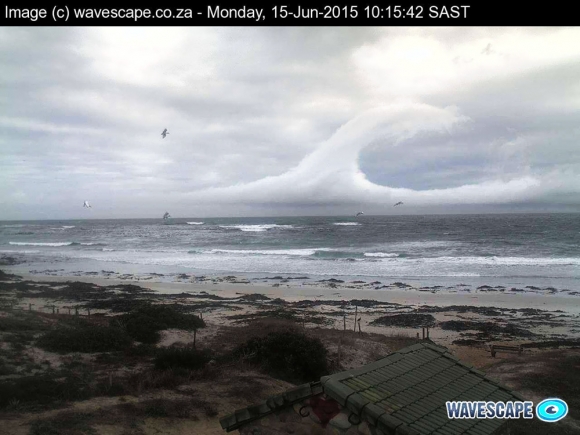
The camera image from this morning. Screenshot by Malcome Logie

A KH instability on the planet Saturn, formed at the interaction of two bands of the planet's atmosphere. Photo Wikipedia
Numerical simulation of a temporal Kelvin–Helmholtz instability