


The Sustainable Slide
Thursday 3 March 2016 Much hooha broke as Kelly Slater's wave pool hit the Web with perfect Coca-Cola barrels that slid across our vision like liquid glass. But is it possible in the way they say, asks Craig Jarvis
{vimeo}149396475{/vimeo}
How does Kelly Slater's wave pool work? Well, apart from apparently getting its energy only from solar power (but many suggest more like the grid where renewable energy and all other energy enters), the engineers are mum. Kelly is not saying. Even the website didn't co-operate: www.kswaveco.com was down at the time of writing, which seemed curious.
Anyhoo, is Kelly Slater's wave pool like the Colonel Saunders' secret recipe, when silence indicates concern rivals will replicate the technology? That's saying something - must be unique technology, or clever spin.
What we do know is that the waves - when the wave pool is launched some time in 2018 - are created using renewable energy from, you guessed it or didn't, Pacific Gas and Electric.
You may or may not remember them for the payment (enforced by court order) of US$333 million to the people of Hinkley, California, in the early 90s after contaminating their groundwater with hexavelent chromium.
Erin Brockovitch? Julia Roberts? Yes that one. With that all said and done, is it possible to rely 100% on solar energy considering the huge amount of energy required (a big low pressure is equivalent to many nuclear reactions)?
We got the lowdown on whether the Kelly Slater Wave Company solar project can work.
Energy is required for every aspect of our lives, from food production to waste disposal and absolutely everything in-between. Paying for energy, in one way or another, is the thing that keeps everyone in hopeless slavery.
As a result the world is staring intensely at renewable energy, with solar and wind being the two chief proponents in the game. Yet many people do not understand the basics of solar energy. The scale of it all, the basic energy inversion process, the cost and the electrical distribution methods are all factors that are intrinsic to renewable energy systems.
We all know that, in essence, the sun beats down and we somehow use it to make things turn, or to make things warm, or make large volumes of water move, as in the Kelly Slater Wave Company.
http://magicseaweed.com/news/kelly-slater-steals-wsls-thunder-with-groundbreaking-announcement/8451/
We decided to try and break down how it all works from an energy front.
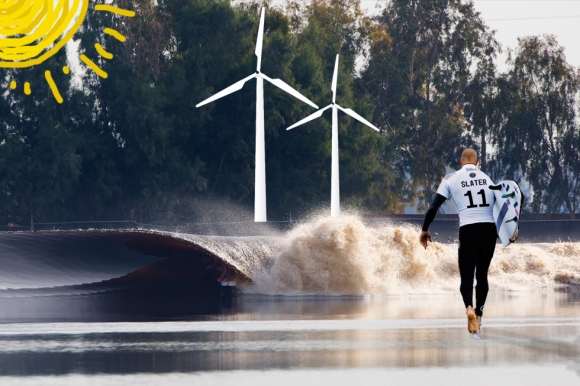
NEW DAWN: Can Kelly's Wave Pool be entirely powered by the sun, and not other sources?
We are going to explain the workings of solar, being the only source of power for the greatest artificial wave in the world, as well as elucidate on the decision made by Kelly Slater to utilize a 100% solar, zero emission operating system for his wave.
So, the sun shines on a solar panel, generating electricity. This electricity is stored in batteries. A special machine called an inverter converts the battery current (DC) to electricity we can use in the house (AC) ... or run a wave pool.
To make a wave such as the one Kelly rode is going to require some serious juice. A domestic system utilised as a back-up for when the lights go out due to loadshedding (rolling blackouts) or simple power cuts, consists of a 3.6kwh battery bank, enough to keep power turned on for about four hours. These power outlets include things like lights, alarms, fridge, television, hi-fi and a power point for laptops and ipads.
Kelly’s wave, however, is going to need a lot more than that. We spoke to Terry Billson, CEO of Genergy ( www.genergy.co.za ) and a core surfer, as well as his team of solar specialists, to get some sort of perspective.
At a visual guess, how much energy to run this great machine?
Genergy: The amount of energy needed is totally dependent on the volume of water that needs to be displaced, as well as the wave frequency.
Ok. Thumbsuck some numbers for our readers please.
Right. Let’s say that the wave is 2m high on the vertical and represented by an equal triangle. This triangle will have an area of 2.39m square. Assuming the wave is 50m wide and multiplying that by area, we get the total volume of the wave, 119,5 cubes.
Ok, still with you.
1 cube of fresh water is equal to 1000kg in weight, thus we are looking at 119,500 kg of water. The equation from there is: Work Done = Moving Force x Distance.
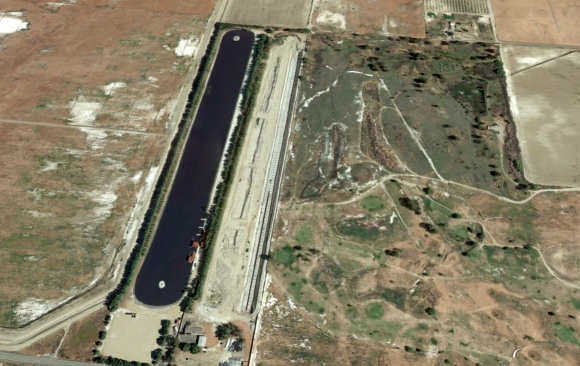
SUN STRIP: They say the wave pool can be found in California near Lemoore. Pic Google Earth
Now it gets a little bit more complicated. The force required to move the mass must be equal to or greater than the mass. I this is achieved, we have movement. Therefore, we convert the mass to Newton to determine the force required: 119,500kg = 1,171,894 N.
Then we multiply distance of 150m (length of ride) to give us the work done or energy in each kiloJoule of 175 797kJ. Then we convert this to kWh (same unit of measure as when you buy prepaid electricity from the convenience store) = 48 kWh.
So 1 wave every 6 minutes or 10 per hour comes in at 480 kwh used every hour. If the machine runs for 8 hours, this equals 3840 kWh per day.
If we assume that an average household uses about 30kWh a day, this is roughly equivalent to the usage of about 128 households. This is not crazy at all, considering. Let’s talk about the cost. By Mr. Slater buying pure 100% solar energy, he has to pay a fee on top of this, the so-called ‘green fee’.
Green electrons do normally come at a slight premium. This would depend on PG&E’s models.
If the energy is coming from a large energy corporation like PG&E would it come in such a form so that there is still a need for plants/inverters/battery packs etc.? How would the juice be delivered?
The green electrons will come from a large-scale centralized renewable site. It will be distributed through a normal grid. This will have to be a pre-requisite if Mr. Slater is buying green electrons.
Doesn’t electricity mix freely? How would one be able to guarantee that the electricity that Kelly is using is not just a mix, as from a massive hybrid system?
Yes, they could be mixed, he may not only be using green electrons but he will be paying the green electron cost, which will in turn stimulate the green economy either way. He would need the PG&E guarantee that his machine is only using green electrons.
Thanks. Any other points? Imagine that machine in Joburg!
So despite a few very minor grey areas, the business model and ideology is sound. The very thing that is holding the development of wave pools back – the huge cost of electricity to run them – has become doable, and there is something very tangible in the future.
The cost of renewable energy is also going to decrease dramatically. The simple economies of scale mean that the photovoltaic panels and other solar energy working parts are dropping in price due to massive worldwide demand, the technology is improving on a daily basis as a result of this demand, and the world is passionately focused on this aspect of energy, with fossil fuels being finite, and nuclear systems rapidly becoming more unpopular globally. By the time Kelly’s machine goes live, some time in 2018 so we hear, the costings could be well in his favour.
The man is living in the future.