


Surfers Ride Tsunamis
Friday 01 April 2011 Cape Town surfers rode a series of mini-tsunamis last month, US oceanographers have revealed to Wavescape after a groundbreaking study in the aftershock of the Japanese earthquake.
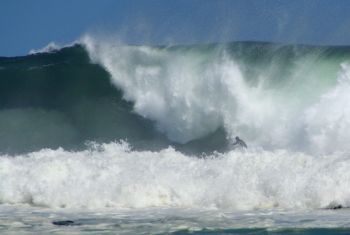
A series of deep sea earthquakes triggered by the Japanese quake on 12 March resulted in a sudden increase in swell from a solid 12' to 25-30 feet at big wave spots in Cape Town on Monday 14 March.
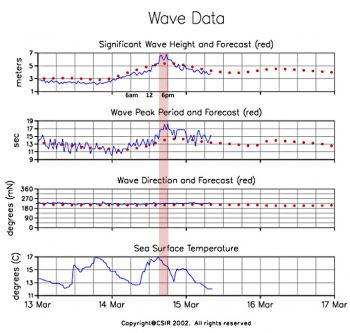
Surfers have been wondering why the swell spiked sharply between 4 and 6pm on that day, requesting Wavescape to study the anomoly. The CSIR Waverider buoy at Slangkop measured waves at 25 feet at 18 seconds but the Wave Watch III forecast only showed 12 foot waves at 14 seconds.
In a stunning revelation, experts at the International Centre for Environmental Prediction (ICEP), said that the unusual swell ridden by a small group of surfers was in fact what are called "capillary tsunamis" created by subtle shifts in the earth's crust off the coast of the Falklands, a seismically volatile region due to nascent geo-thermic instability.
Professor Dirk de Hoog, the head oceanographer at ICEP, told Spike: "The 8.9 quake off Japan on the 12th set off a sequential aftershock that rippled through the earth's crust, with many small, barely discernible quakes around the world. Six hours after the main quake, a fissure 125 nautical miles east of the Falklands ruptured sideways, not vertically as is often the case with dangerous tsunamis.
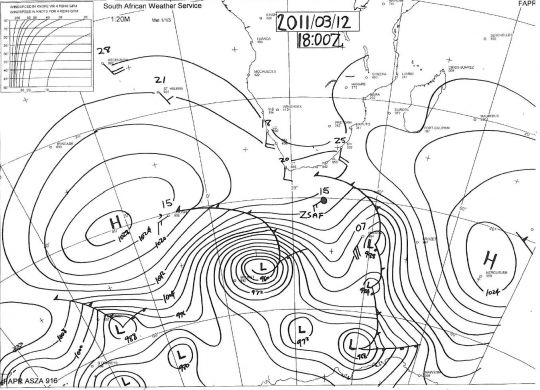
"Our data reception computers were able to detect the propagation of the mini-tsunamis with an orginal period of 23 seconds. From a oceanographic perspective - and this is exciting for us - the tsunamis formed west of a very powerful low pressure cell forming 500 nautical miles southwest of South Africa that peaked on 13 March.
"The tsunamis passed through the storm swell being generated by the storm. Instead of the longer period tsunami swell passing momentarily THROUGH the surface swell, they in fact JOINED together due to a process called 'frictional dynamic fetch'. The technical term is Baroclinic Uniform Lithographic Longitudinal Seismic Holistic Infragravity Trauma.
"Thus a peak group of larger, more powerful waves continued to propagate, arriving on the coast at precisely 4.24pm on Monday 14 March, and lasting for three hours," he said.
This was the reason for the anomoly shown on the CSIR Waverider buoy, said de Hoog.