


Standup Paddle Battle
Thursday 14 September 2017 If you stand or kneel on a craft and use a paddle or don't use a paddle to ride along water, what are you? Spike looks at the Olympian power struggle between surfing and canoeing.
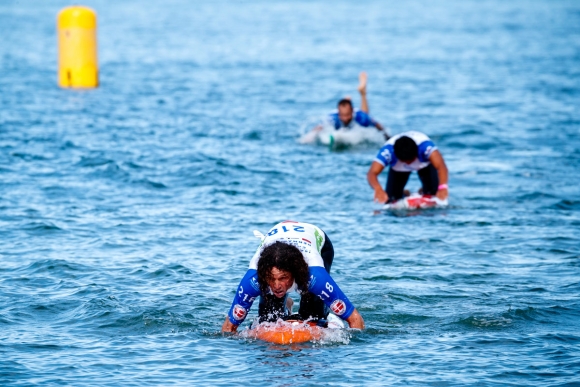
PRONE PADDLE: South Africa's Kit Beaton in action last week in Denmark. Photo ISA / Reed
Apart from being a person who is quite fit, with a strong muscle core, most people would probably call you a standup paddleboarder. I mean, you have all three words in the scenario: a person standing up, a paddle and a board. But is a standup paddleboard (SUP) a canoe, or is it a surfboard?
Hang on. Surely if you stand on a board and ride waves, you're surfing, paddle or not? Yes. Probably. What if you stand on a much longer board and race around buoys against a bunch of other people on similar craft over kilometres of flat water inland far far away from the ocean? Is that surfing? Probably not.
It gets even further removed when you lie or kneel on a board and paddle through flat water. But you've lost the paddle and are using your arms and hands now. Ostensibly, you're moving back towards a surfing derivative, are you not? I mean, that's how surf lifesavers do it, and they're in the ocean having to deal with surf, as in waves, right? mmm.
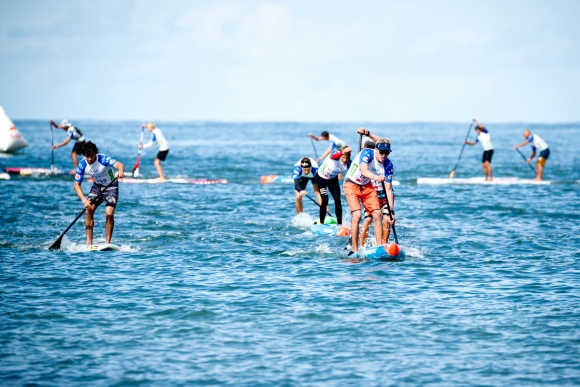
BOAT PEOPLE? Technical SUP racers in full ... er ... paddle at the Worlds. Photo ISA / Reed
These confusing questions came to mind while watching the different disciplines at the ISA World SUP and Paddleboard Championship, which ended last weekend in Denmark. Team South Africa came 10th overall with Cape Town’s Tamsyn Foster reaching the semi-finals of the SUP Surfing division, while we got vaguely satisfying results in the other prone and stand up paddleboard events.
Flat water racing with facades of beautiful, old buildings as the backdropThe worlds, attended by 286 athletes from 42 nations, started in Copenhagen before moving to the NW coast they call “Cold Hawaii” for the SUP Surfing and racing. In the city, there was little suggestion of surf, surfing or waves. This was flat water racing with facades of beautiful, old buildings as the backdrop. This morphed into a ragged, messy ocean and windswept countryside for the surfing heats.
When I first logged on to the live stream, the constant commentator references to Hawaii seemed a lame joke, but suddenly the wind switched and the sloppy 3' windswell began to show a little promise, with emphasis on the little. Still, it's this form of outreach by the ISA - spearheaded by the incorrigable and slightly South America-biased ISA President Fernando Aguerre - to the far-flung corners of the globe that is reaping handsome dividends in participant numbers, and the number of nations joining the ISA fold.
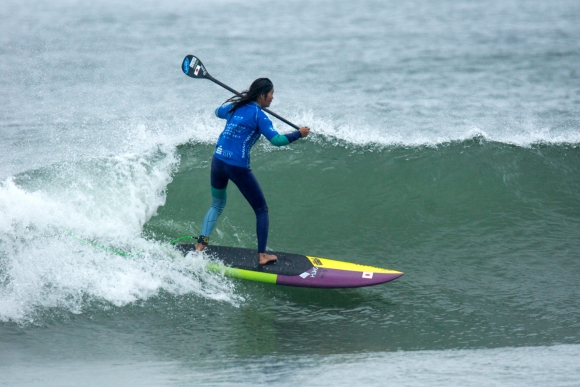
SURFING BOARD: Yuuka Horikoshi (Japan). If you Photoshop the paddle out? Photo ISA / Evans
But I digress. True to the contradictory elements within SUP and its offshoots, a squabble has been brewing between the International Canoe Federation (ICF) and the International Surfing Association (ISA) over who deserves to be the world (and Olympic) governing body of arguably the world’s fastest growing sport. The ICF has challenged the ISA’s assertion it is the de jure custodian of all things to do with SUP and paddleboard.
SUP originated in Hawaii and is therefore more closely aligned to the oceanThe ICF says that the use of a paddle means you are on a canoe. The ISA rejects this, claiming it has been managing paddleboarding events as surfing for years. This is backed by the narrative - endorsed by that arbiter of universal truth Wikipedia - that SUP originated in Hawaii and is therefore more closely aligned to the ocean and surfing.
Things got a bit tense when a prickly Aguerre said the ICF had belatedly jumped on the SUP bandwagon because they had belatedly realised how popular SUP is and now all of a sudden wanted a piece of the action. At the heart of the matter is Olympic-level control. The ICF manages several canoe and kayak disciplines at the Olympics, but surfing is new at the Olympics game, making things even more tetchy. Aguerre is not behaving like the "new kid on the block" however, and is adamant that the ISA has been managing paddleboarding for years.
The ICF and ISA have requested mediation from the Court of Arbitration for Sport (CAS), and the case has been before CAS since July 15.
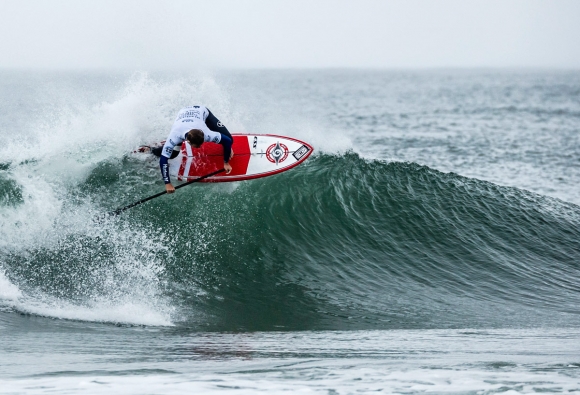
SURFING: Harry Maskell (AUS) launches off the lip in Denmark. Photo ISA / Reed
I can understand why there is a slight scizophrenia about SUPs and paddleboards. Some paddleboards are designed like surfboards to ride waves, and they're getting shorter and lighter by the minute. But others are built longer and thinner and more boat-like for greater speed over flat water on lakes, rivers or the ocean.
You stand on some, and kneel in the prone position on others. For the latter, you don’t use paddles. You use your arms: just like paddling a surfboard, or as mentioned above, like a lifesaver does on his craft. It cuts both ways.
This got me thinking about criteria, and what types of surf craft fit where. And I realised, some don't fit anywhere. Surfing purists demand that you be standing. Some stand on longboards and short boards and other boards, but lie down on bodyboards and kneel on kneeboards. People sit on waveskis but lie down with no craft at all when they body-surf. I have seen waves ridden with kayaks designed for white-water rapids. What about waterskiing with a surfboard, or riding a standing wave with bodyboard or surfboard? The list goes on.
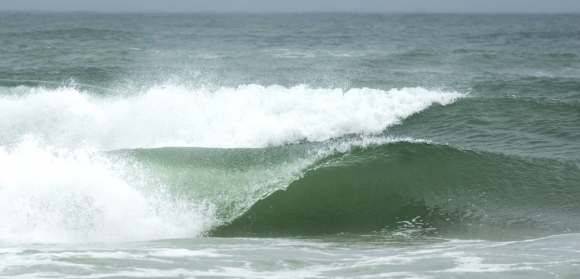
ALL ABOUT THE WAVE: Cold Hawaii shows off its Cold (mini) Pipeline. Photo ISA / Reed
Waveski is an interesting one. The World Waveski Surfing Association (WWSA) has opted to move more towards canoeing. According to veteran waveski competitor Phil Smuts, the WWSA was taken over a few years back by European nations, who are members of the ICF, and they "immediately voted to join" the ICF.
It's understandable I guess. You are seated in a waveski AND you’re using a paddle. But you’re still surfing. Many waveski riders wouldn't agree their sport is more canoeing than surfing. It’s a tough one. It doesn't help that the ISA has not shown all that much interest though, as far as I am aware.
There are other examples of identity crises in sport. However, you couldn't call it a crisis for windsurfing or kiteboarding. In fact, it's the opposite. They have their own custodian groupings and affirm themselves proudly. This organic separation from surfing perhaps originates in their evolution. Wave riding only came a lot later in both sports after they started sailing on flat water.
The language used by the ICF on their website is quite curious, and enlightening perhaps. Under the category “White Water” they list the stuff you associate with rivers and rapids, such as wildwater and slalom. But one discipline they list is Ocean Canoe Racing. Huh? Literally, a broken wave is white water, but this seems like a cheeky form of cultural appropriation.
Over to you Court of Arbitration.