


Shark False Alarm
Monday 2 April 2012 The big shark spotted at a popular surf break near Cape Town yesterday has been identified as a whale shark, according to shark experts, but not before giving surfers a fat skrik. Photos by hang glider Ross Hofmeyr.
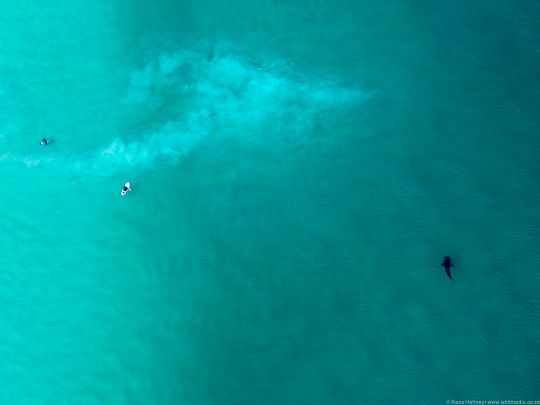
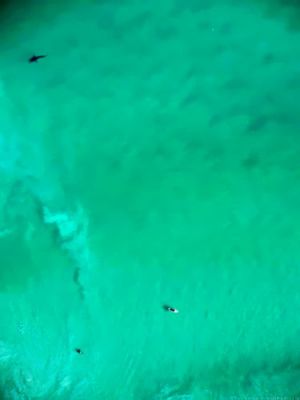
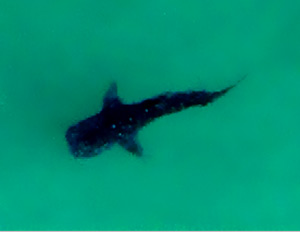
Alison Kock of the Shark Spotters and Save our Seas Foundation Shark Centre in Kalk Bay said it was more than likely to be a whale shark from the blunt, rounded nose.
However, surfers enjoying a perfect Sunday - sunny and calm with a 2-3' groundswell buffed by light SE offshores - got the fright of their lives when a large dorsal fin appeared moving towards them.
Meanwhile above them, two hang gliders were cruising along. Ross Hofmeyr, who took the pics, wrote this on his blog:
"I was joined this morning by a fellow powered hang-glider pilot for a sortie from Hout Bay. Due to my current lack of a PHG, I was flying my PPG (powered paraglider) while he took to the sky in a Zee PHG trike of South African construction. We flew high most of the time to avoid some turbulence from the low-level south-easter, but not too high to notice this in the water near some surfers and kayakers off Long Beach, Noordhoek. Closer inspection reveals it to be a small (large = 12m!) Whale Shark – a very rare find in the cold Atlantic.
"According to an expert I consulted, it is exceptional to spot a whale shark anywhere on the West Coast, and the specimens that are found are usually dead. One theory is that they drift around in warm eddies of the Mozambique Current and then become “lost” and die when the warm water dissipates. I think they are like my mother, and only dive in warm water." (check Ross Hofmeyr's blog here)
Big wave special Simon Lowe said the dorsal to tail fin was about four metres, which put the shark at 7 metres long. However, the guys in the air were able to measure the creature in relation to the surfers, putting it at around 5-6 metres. Either way, it was big for a white shark, but small for a whale shark, who grow to 12 metres.
Lowe was sprint paddling across from Kommetjie on his big wave board to a popular beach break off sand dunes as part of his training for winter. Part of the route entailed paddling across "crystal clear water straight across the bay".
Lowe said that he had been trying not to think about a shark "that swam under Ross Murray and Chip Snaddon last Sunday."
As he neared the surf zone after 15 minutes he noticed two surfers, one of whom turned out to be Ross Murray and a Kommetjie surfer called Terence.
"Still sprint paddling I look and about five metres to the left out to sea - I was basically on a collision course with this beast with a dorsal fin swimming in my direction. At that instance Ross checks the thing - now I am really sprint paddling. Thank god we are in the wave zone and get to shore."
Other guys on the beach said it came into very shallow water, and that it was so fat it was probably touching the sand.
Not have the benefit of an aerial view, the surfers on the beach could not make a proper ID other than it was a white shark.
Lowe said "this thing does a turn and comes in to about waist deep water. It makes any of the videos taken of the sharks at Fish Hoek look meek. It only came in once and did a sharp turn which indicates it wanted food. I hope it realized we were not a seal and in hindsight it must have otherwise I am sure it would have chowed me."
"It then meanders just outside the wave zone to the Kommetjie corner of the beach, does a u-turn and commences to go back along its tracks for all on the beach to see."
Surfers out in the water continued surfing after realising it was a whale shark, but those on the beach were convinced it was a large white shark.
A hang glider took a photo (above), and from this photo, representatives from Shark Spotters, including Alison Kock, the renowned shark scientist, have identified it as a young whale shark, with it's very blunt round head.
"Hi guys, from this photo this is a whale shark not a white shark. The head is too rounded and broad to be a white. Very interesting non the less and we have passed the sighting on to our colleagues researching whale sharks in KZN," the Shark Spotters said on our Facebook page (click here).
The incident follows the death of a juvenile whale shark that died after beaching itself in the Soetwater marine reserve just south of Kommetjie recently.
An entry in Wikipedia says that the first recorded sighting of a whale shark took place in Cape Town in the 1800s.
"The species was distinguished in April 1828 after the harpooning of a 4.6 metres (15.1 ft) specimen in Table Bay, South Africa. Andrew Smith, a military doctor associated with British troops stationed in Cape Town, described it the following year. The name "whale shark" comes from the fish's physiology, being as large as many whales and also a filter feeder like many whale species." - Wikipedia