


Rats in a Cage
Friday 1 October 2010 After reading Hot, Flat and Crowded by Thomas L Friedman, and then seeing End of the Line, a disturbing film about the commercial extinction of fisheries, Chris Mason works himself up into a lather.
"All this f*cking around is irritating me. The challenge is upon us. It's a new dawn, but where the sun shone there might be only smog. Forests are scalped to make big macs, and giants of the sea are all devoured in the name of fashion sushi. All the while we breed and breed. Then what? Like rats in a heated cage we may just turn on each other in a frenzy of survival."
(This was my rant on Facebook the other day in a moment of anger and frustration after reading Friedman's book (Audio Preview) and then watching the deeply disturbing film End of the Line.)
Then I began thinking about something small but important in my life: coffee.
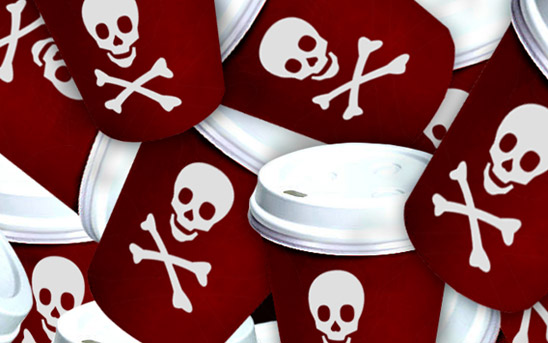
I drink coffee almost every day. In the morning, I go to my local coffee shop and get a cappuccino in a disposable cup. Then I sit down at my desk and drink it while settling into the day. A nice little ritual. But later, with a flick of the wrist, the empty take-away cup goes sailing into the bin. It sits there, and the next day I get another coffee in a disposable cup. Whizz, plonk. Now there are two. Whizz, plonk. Spike just had a coffee. Within a few days the bin is full, jammed with empty, useless coffee cups.
I’ve been thinking about all the coffee cups our small company of two uses. Let’s say two a day all week. That’s 10. Multiplied by 4, that’s 40 a month. Multiplied by 12 is 480 coffee cups a year, for a small business that prides itself on having a low carbon footprint.
And what did it take to make the empty, stained coffee cup lying in the bin? Let’s see; energy from fossil fuels, paper, and some plastic. But what happened when that plastic and paper and energy were made? A study of the impact of the disposable coffee cup done by the Environmental Defence Fund estimated that to manufacture “one paper coffee cup with sleeve (16 ounce)…the CO2 emissions is about .11 kilograms (.25 pounds) per cup with sleeve - including paper from trees, materials, production and shipping. The loss of natural habitat potential from the paper coffee cup (16 ounce) with a sleeve is estimated to be .09 square meters (.93 square feet). Source
That’s one cup. So over a year I alone use 240 cups and create 26. 4 kgs of CO2 emissions and destroy 223 square feet of natural habitat. That’s just me! And only assuming I drink a single coffee! If you take those estimates and multiply them by all the people in the world drinking coffee from disposable cups, the results will be horrifying. And that’s just coffee.
But I don’t want to spiral into a deep statistic induced depression about how fucked everything is. That’s not the point. The point is that if you make choices that are seemingly unimportant, you can really alter the amount of damage done. Ok so now I take my own reusable coffee cup in the mornings. It wasn’t that hard to do, and the coffee stays warmer for longer.
Now what else is easy to do? I think about waste. Recycling. Yes, it’s pretty simple and tota1ly vital. Why? Well, our landfills are almost full. South Africa creates 42 million cubic metres of waste per annum (source) and truth be told, soon there’s going to be nowhere to put it. Gone are the days of the ‘I’ll just throw it in the bin and it’ll disappear’ mentality. If we are not careful, those milk bottles are going to come back and haunt us all.
What else? How about water? Well, half the country has massive water shortages, so what about turning the tap off while we brush our teeth. The realisation must be that we have choices for every action we make, to do good or bad, and that makes things more interesting. The vegetables we buy, the fish and meat we eat, the eggs we fry, how we get to work, to the jol, what we wear, even if we turn the light off when leaving the room. Everything. There is a choice and an impact in everything we do.
Again, this is not a call to make you into some militant activist freak who can only eat organic cashew nuts fallen naturally from the tree. This is about realising that your choices count, now more than ever. This is about the bigger picture, about the lie that has been so perfectly painted for all of us our whole lives. The lie of the consumer lifestyle that tells us to buy more and eat more and use more and not look back as the waste comes flying out the back. The sooner we realise that accountability starts with us as individuals, the better. And it’s not just accountability, it’s about empowerment. The opportunity to make a difference is there, we just have to take it. No one else is going to clean up this mess if we don’t, and the governments and Fatcats will keep on exploiting the world and our flaccid idiocy until we stand up to a system that is clearly flawed.
And it won’t be easy, breaking this addiction to consumption. It’s going to be a battle, a war of monumental proportions, against the most deadly enemy we have, ourselves.
So there are two choices, either we start fighting to forge a new way of life, one that sustains human life on earth. Or we go on like we are, sitting on the couch, staring blankly at the TV and munching on propaganda, while the oceans empty and the landfills overflow, until Tuna are fish you find in aquariums, and aquariums are places where animals that used to live in the sea are kept.