


Rainbow Nation
Tuesday 24 February 2015 Greenpeace vessel Rainbow Warrior steamed into Seal Point, St Francis, last week in support of the bid to stop the Thyspunt nuclear power station, writesCraig Jarvis. Photos Clive Wright.
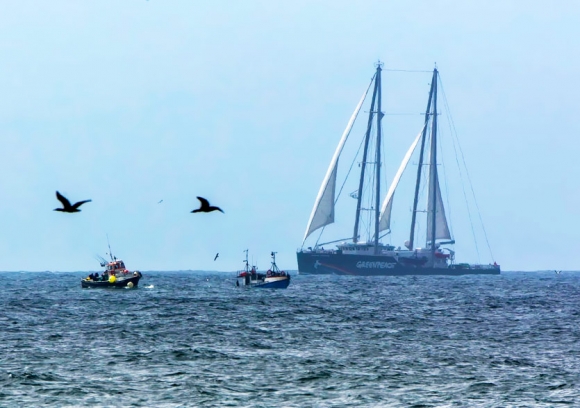
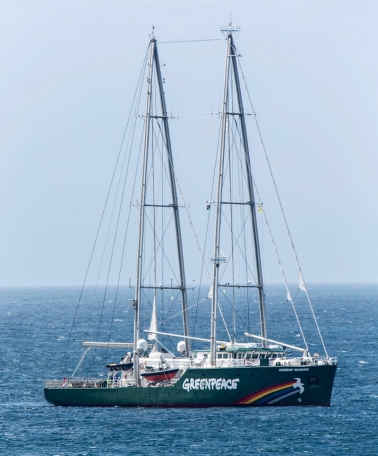
A quiet dorp like Seal Point doesn’t have much excitement, apart from maybe the weekly special at the Spar, or when a band plays at Stix. But that changed briefly last week when the Rainbow Warrior sailed into St Francis Bay.
She was here to support the Thyspunt Alliance http://www.thyspunt.org/ that aims to prevent construction of a nuclear power station at Thyspunt, 10km from St Francis.
Trudi Malan, spokesperson for the Thyspunt Alliance, spoke out about the selection of possible nuclear sites, the flawed Environmental Impact Assessment and the fact that when the sites were selected, in the 1980s, the calamari fishing industry, which will be decimated by the station, was not even in existence.
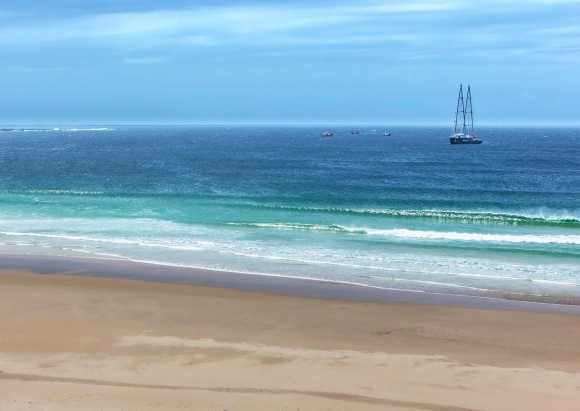
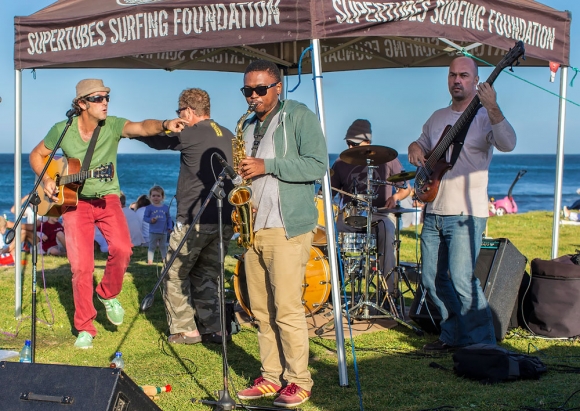
The locals gathered all dressed in white, the South African flags were waved, and the picnic baskets were opened as the community, surfers and others, gathered together from Cape St Francis, St Francis Bay and Jeffreys Bay to show their support. Local band The Brothers jammed, the Rainbow Warrior bounced around in the strong south-westerly wind, and a few surfers went out and caught a few tiny waves in the beachbreak.
“Greenpeace believes that controversial plans for new nuclear investments are not a solution to this country’s crushing electricity crisis. In fact, nuclear projects are a distraction from the real solution to the crisis: investments in renewable energy solutions,” said Melita Steele, Senior Climate and Energy Campaign Manager for Greenpeace Africa on their Facebook page - https://www.facebook.com/notatthyspunt
“if this country continues to pursue these controversial nuclear expansion plans, it is the South African public who will end up paying the price. New nuclear projects are likely cost up to R1 trillion, which would bankrupt this country and force skyrocketing electricity prices, while at the same time failing to deliver on the electricity that South Africa needs today,” added Steele.
The event was well attended, and the locals as well as all the children in the area came down to show their support.

The social implications of a nuclear power plant being built in the area are dire and far-reaching, the environmental implications are possibly devastating and have yet to be properly researched and dealt with, and for us the surfers there is a good chance that many of the local breaks could be altered and destroyed forever with the movement of a few million tons of sand in the area. Some waves might be lost forever, and some might be improved, but with world class waves like Seals, Bruces and Supers all in the hood, as well as a couple of lesser known spots, the consequences could be tragic.
The price tag on the new proposed nuclear development in South Africa has been loosely stated as R1 trillion Rand, which could go incredibly far if invested in renewable energy solutions.
Local Seal Point surfer Terry Bilson is well versed in the alternatives to nuclear energy. Terry is the owner of http://www.genergy.co.za/ - an alternative energy company that specializes in home energy efficiency and alternative energy generation.
“Genergy is a business focused on sustainability and more specifically sustainable energy,” said Terry, when Wavescape chatted to him about nukes, alternatives, Greenpeace and the Rainbow Warrior recently. This is his take.
Sustainability is all about not taking from future generations what we need for today.
Coal fired power stations are a perfect example of unsustainable energy generation, taking coal out of the ground which has been in the ground for billions of years and burning it to drive coal fired power stations, i s a perfect example of unsustainable power generation, firstly because coal is a finite resource and the impact on the climate is now showing.
Nuclear also leaves a trail of highly toxic and radioactive nuclear waste, which we currently have no clear way to deal with.
The cost of nuclear is around R40Million per Megawatt and the environmental impact on the immediately surrounding ocean cannot be accounted for. The primary reason for a nuclear power station being close to the coast is to cool the reactor, which in turn means that it will heat the water and significantly change the environment. The impact on the eco system surrounding the Thyspunt cannot be anticipated.
The renewable options such as wind and solar PV are not only more cost effective but also environmentally less harmful.
As indicative costs, solar PV costs around R17,5 Million per Megawatt but is not reliable due to the solar hours. Wind in the EC is a reasonably good resource and costs around R22 Million per Megawatt.
Genergy are firm believers that the sustainability of this planet is deeply seated in embracing renewables and changing behaviour with respect to current & old generation strategies, i.e. certainly not Coal Fired or Nuclear Power stations.