


Open Letter
Wed 23 January 2013 The so-called Surf Rage incident has sparked a lot of reaction. Here, surf writer Anton Louw feels compelled to reflect on our situation using some historical and social context.
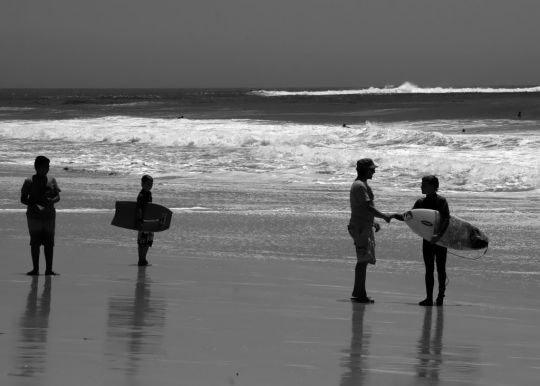
We need to look at how we got to this point, and what it might possibly mean for our future in the waves. The sad part is many of the ills that affect our country as a whole are found in line-ups these days. Greed is one, exclusivism another and violence is the ugliest. The good news is we don’t have to be prisoners of our past. And much like the rest of this country’s still undetermined future, it’s ours to grasp, or let it slip between our fingers.
I don’t know quite when it first happened, or for that matter even where, but somewhere along the line, catching waves became a selfish thing.
I don’t know quite when it first happened, or for that matter even where, but somewhere along the line, catching waves became a selfish thing. We sought to catch many waves, and at the expense of others. We began competing for waves, instead sharing a session. We took the steps down the individualist path where surfing became focussed on waves ridden, and not moments enjoyed. It spread and soon this attitude came to dominate all but the least crowded places. It didn’t have to become like this.
It’s been justified in so many ways. It begs a few questions, though: When have earned the right to take a wave from someone else? What gives you this precedence? And then why are these good reasons? I don’t have answers here. You can answer them for yourself. And saying that ‘that’s the way it is’ is not good enough. It doesn’t have to be like this. Imagine saying this: “Nah, I didn’t get anything good on this epic day. But I saw X and Y get cookers, and just being out there was such a jol.
Yet, here we are. The most common cause of angst in the line-up can be attributed to localism. Localism, as I’ve seen it expressed (in most instances - I’ve happily experienced exceptions, too) isn’t about custodianship, about teaching manners to newcomers, or maintaining a sense of order when things get busy. It’s a form of exclusivity. It’s a method of drawing a line between ‘us’ and ‘them’, and denying ‘them’ of any privileges that ‘we’ may enjoy. It pushes anyone outside a tight circle to the periphery and leaves them to fight for scraps on the margins. That might sound familiar in the broader context of our country’s history.
In creating these tight rings we push as many people apart aside as possible. Reasons fall into 3 rough categories: lack of familiarity, lesser ability, and likelihood of returning aggression. Basically, any excuse to prey on the weak. This means anyone who’s not recognised as from there, not quite as experienced, a girl, or of colour gets marginalised. And this is not only seen as excusable, but endorsed as legit.
Attempts to challenge this system are met with aggression and violence. And this is contagious. The recent shootings in America have prompted researchers to now look at violence as a contagious disease. Staying at home, we managed a peaceful transition to democracy under the auspices of truly great men – icons of our time, true examples of human potential. The international community lauded it and sought to learn from our willingness to discuss our differences and forgive our transgressions. Then we lost our way, because we couldn’t truly get a past an ‘us’ and ‘them’ mind-set.
The incident that set the ball rolling here was a racially charged one. Whether it began as a racial incident, or morphed into that either in the heat of the moment, or because of the angle the media spun is an unknown quantity. Racism in the line-up (or anywhere) needs to end. Not just because of a sense of fairness, but because it will be our undoing in the long term. Having chatted to some coloured surfers since the incident, the most chilling comment was “When you paddle out, you can see the scorn in their eyes.” It’s unclear whether this is motivated by deep seated racism, or part of the attempt to make an unfamiliar unwelcome. But, the offended surfer isn’t going to react well to it. And the race card – justified or not – is often played. The consequences as we’ve seen follow on.
I come from a farming background. It’s an industry battles with the image of being the preserve of white males. Surfing is going to suffer under the same perception unless we actively work hard to avoid it. Then the best case scenario will be apathy from the authorities. Anything from ‘could the city please fix the showers at the beach’ to ‘putting this sewage pipe here will be a bad idea’ will be ignored. At worst, government will actively try to undermine us with any tool at their disposal. Such as deliberately ignoring car break-ins at the beach, or purposefully placing sewage pipes where surf spots are. These are just examples off the top of my head. You may think they’re farfetched, or may come up with even more sinister ones of your own.
You probably won’t agree with this, but we need more surfers in the water. As a democracy, the more we are, the better voice we have. And unfortunately in our racially charged political climate, black voices are recognised above white ones. As inland water resources in the interior become scarcer, our industries will move to the coast. This is going to put enormous pressure on the marine environment. Unless we have a large and inclusive community to defend it, we’re going to lose everything that we have. Then we’ll all know what it’s like to fight for left overs.
And our waves can take more surfers. As a Capetonian, I recently enjoyed a post-work session at an urban spot that was firing with only my mates on it. Just yesterday, I sat on the beach at one of our premier spots with a Californian visitor. He couldn’t believe how uncrowded it was. He said in the previous week he’d been there with no-one out. I could believe him. I’d been there on weekends and had multiple peaks to pick from with me the only taker. And it’s not like I’m especially dialled to these places either. I can’t speak for Durban, PE or the Garden Route, but think back and you know you’ve enjoyed uncrowded waves where you really shouldn’t have. Cities will always have crowds, our best waves are going attract visitors. Much like daily conditions, you can’t do too much about that.
Those who know me have definitely seen me lose my cool. But apart from my weak pop-up, and stiff posture, it’s something that I’m working on. The correct attitude is arguably the aspect that the will help me enjoy my surfing the most. Your attitude is your own – you can use it make your session, or undo it for yourself and those around you. And if you want to use a bad attitude to chase others away, it’s going to count against you in the long term. In the end, you may have caught more waves, but I’ll still be the one smiling and laughing, and you’re still the one pissed off with life.
With all the above, you can dismiss it or take it to heart. I’m not suggesting anyone to go out there and klap the neighbourhood bully into his place. Change needs to come from within. Like violence is contagious, so is stoke. Surfing began with something called Aloha. We have our own Ubuntu. It’s time it made itself known in our waves.
Yours in surfing,
Anton Louw