


No Free Ride
Thursday 17 March 2016 Veteran surf photographer Pat Flanagan gives some exclusive insights into what lacks in our surf industry, as well as the general state of surfing as a whole. He spoke to Craig Jarvis.
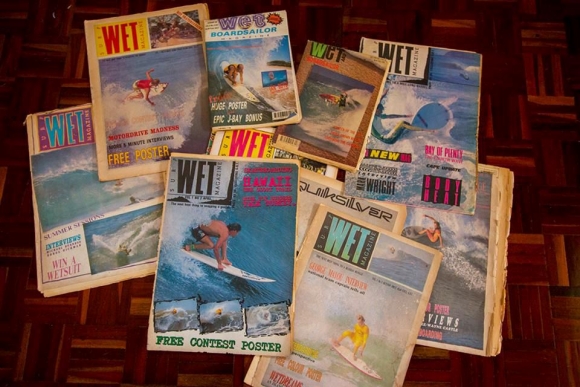
GET WET: Pat Flan produced one of this tabloid surf mag in the 80s. Photo Patrck Flanagan
Pick up any of the earlier surf mags, from the late 70’s and 80’s, and you’ll see classic images with the credit Flanagan to it. A legend in the business, he’s also one of the main manne behind the South African Surfing Legends (website), which is leading onto the High Performance Surf Academy that is to be set up in Durban. Pat has seen it all, and we felt that with the final event in the Future Heroes Coaching Series coming up in Durban, that it was high time for a chat.
CJ: When did you start in the surf industry?
PF: I started surf photography in 1975 ten years after I started surfing. Had my first pictures published in Surfing World Australia, a sequence of Knutto at the Bay of Plenty. Never got paid. That should have been a big red flag for the future. My major goal was to get my work published in Surfer or Surfing magazine. They actually paid. I got a job with Down the Line as photo editor, a tabloid that Mike Tomson did before he left for the USA. He helped me greatly to get established.
What was it like in the surf industry back then?
In Durban it was Safari and Larmont (Lightning Bolt) who ruled the roost. Robbie Ponting’s Faith shapes made in a very down-tuned factory in JBay were sweet. This was the era of the continuous curve single fin. He had it down. Gotcha and Instinct hadn’t been born yet. So it was like the calm before the storm of big surfing brands. Mike Larmont saw future potential in creating or leveraging surf brands. Zigzag was in its infancy and was primarily created as a marketing vehicle for his brands. The whole vibe around surfing was very organic and rustic, no less competitive than it is today, but more laid back. Pukka Shells, mirror shades and loud prints on linen shirts were big fashion items.
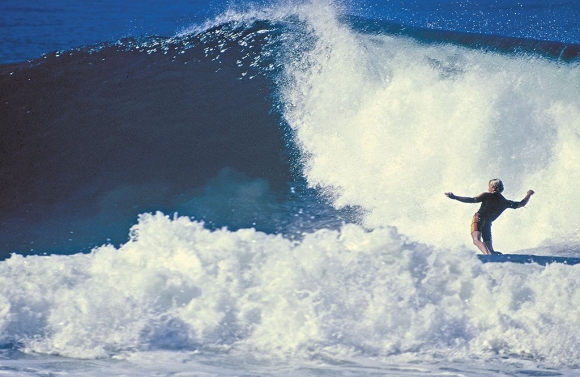
ROCK SOLID: Peter Townend styling at Cave Rock in classic PT form. Photo Patrick Flanagan
What was the greatest thing in surfing in the 70’s in South Africa?
Gavin Rudolph, Jonny Paarman and Shaun Tomson. Before they were established as top end international surfers, the landscape was very dark. The fable of JBay had spread to California and Australia and many traveling surfers brought in bags of hallucinogenic drugs. Psychedelia with all its’ bullshit was pervasive. Purple haze. Then Shaun and Michael stepped up and changed all that, establishing the IPS. Johnny and Peers Pittard were vanguards of Cape surfing. Along with Gavin they ruled Supers. Performing on the North Shore of Oahu was the ultimate goal of just about every competent surfer.
Who was the best surfer in the whole world back then?
Shaun, Rabbit, Ian Cairns and MR. The whole Free Ride generation. In the early part of the decade Gerry Lopez and Barry K were the best. Eddie Aikau was the big wave king.
You worked for ZZ and then started a mag What was it? How long did it run for?
I’ve never worked for Zigzag formally. I was a contributor. I did work for Surfer Magazine for about 15 years. Paul Maartens and Paul Naude also worked for them. Before 1981, they would send out the likes of Jeff Divine and Darrell Jones to cover the SA leg of the tour. Then they were happy that us three could do the job and that was a big deal for us. Towards the end of the eighties, I started a tabloid mag called Wet. It was a lot of fun. I took Dean Grobbelaar and Carl Roux to Reunion in ‘89 and cracked some good and big St. Leu and a memorable morning at St Pierre. I lost interest and moved on when the publisher started calling shots that, in my opinion, wouldn’t cut it, and decided to pursue a career in advertising and marketing. That shift taught me a lot and gave me a new direction.
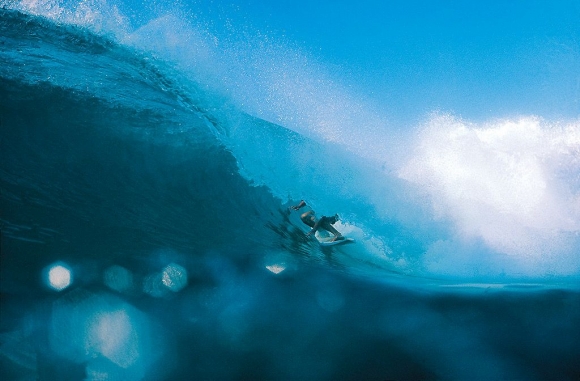
AFTER ACTION: During the Gunston 500 in 1981, Durbanite Mike Savage pulls in on the best
day I ever saw at the old Bay of Plenty. Photo Patrick Flanagan
What else did you do?
What didn’t I do. Advertising and editorial photography, journalist, copywriter, TV commercial production and direction, marketing exec for international retail brand, web design, graphics, SA Navy, dock worker, taxi driver musician, and a cricket coach. I also ran the global marketing campaign for Instinct from ‘83 to ’87.
Surfing has changed a lot. What is the biggest negative about surfing today?
When surfing went corporate in the nineties, an essential element was lost. Before we knew it, the heads of global surf brands were calling the shots on - and in fact owned international competitive surfing. The result was a structure set up to suit their purpose. The CT and QS evolved into what it is today. The QS in its current form is just not cutting it. There’s got to be another way. Social media and the Internet are changing the face of surfing in so many ways. As the trend away from paper publications grows stronger, I personally don’t think that the owners of surfing industry real estate have fully grasped the potential of the Internet. Conversely the proliferation of garbage especially on social media has undermined the integrity of surf photography and journalism except at the very highest level.
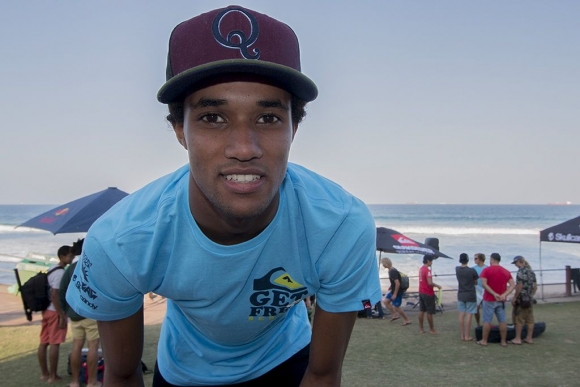
ON THE MARCH: Michael February oozes talent. Photo Patrick Flanagan
What is the best thing in surfing now?
The diversity of what people are riding is the best. Fifteen years ago board design was all about the three-fin, low volume performance board. Nowadays, anything goes, bringing the fun element back into surfing. Twin fins, no fins, longboards, chopped noses (the Vanguard) are all relevant and there’s no real stigma attached to surfing these as there might have been before. Ride anything, surf everything and have fun is the new mantra. The standard of top-level surfing is stratospheric and those magic clips of John Florence or Julian Wilson are a highlight to look out for. The WSL live feed on the CT is also watched with relish.
How did SA Surfing Legends (http://southafricansurfinglegends.com/) come about?
It started with a post I put on Facebook saying that I’d dig to do a surf trip and, I’d even do the dishes. I got a mail from Will Bendix at Zigzag suggesting a Mentawais trip with some surfers from the seventies and eighties. Graham Cormac (CEO of Legends) thought a trip to JBay would be more appropriate. We went to Sandton to see Gavin Varejes, who started South African Rugby Legends (a group of ex rugby players who amongst other things, give back to that sport by doing coaching clinics for development kids in the Western Cape) to see if he could help us establish Surfing Legends. He did.
Our objectives were simple. Get previously successful surfers to pass experience and knowledge and winning culture to junior surfers. So in August, we gathered a bunch of surfers and put together a week in JBay, during which time we introduced the object of the Legends to the group. The group consisted of Dave Fish, Chen Sagnelli, Peter Lawson, Dave Hansen, Spider Murphy, Bruce Jackson, Tich Paul, Solly Berchowitz, Ant Brodowicz, Jonny Paarman, Mike Larmont, Mark Price and Cheron Kraak. Eventually there was consensus that much needed to be done, so we set aside time to embrace the challenge.
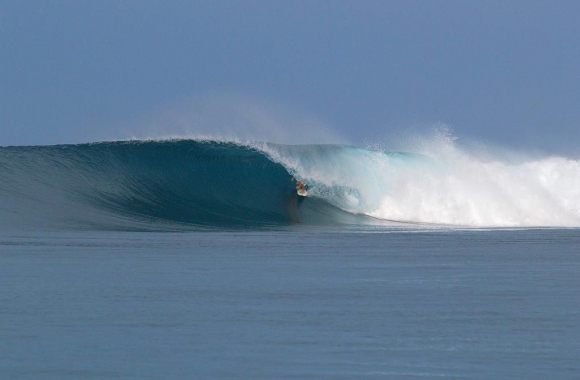
BANK BARREL: Bank Vaults in the Mentawais takes no prisoners. Wes Hall. Photo Patrick Flanagan
What have been the biggest challenges to setting up SASL?
Uniting a diverse group of highly influential surfers with many years of experience in competing at the highest level, with a common vision and a set of goals that will provide junior surfers with the wherewithal to make an impact on the international stage.
Despite what we’ve achieved up until this point, there are still a lot of armchair critics out there looking to poke holes into the concept. However, Surfing South Africa has supported us and we know that. Even though we have detractors, what we’ve done thus far has laid a foundation to making a material difference to a number of talented junior surfers whom we work with.
What are the best things you have seen since starting the SASL?
We’ve been working loosely with young surfers in the process of growing. It’s too early to be claiming success, but in time the work that guys like Simon Nicholson and Barry Campbell and others will undoubtedly bear fruit. Our greatest challenge is happening right now - we are in the process of signing off on the High Performance Surfing Academy, a dedicated platform that will be available to elite surfers and others with the prime objective of delivering high quality surf coaching. The challenge after that is to roll out programmes to other SA centres.
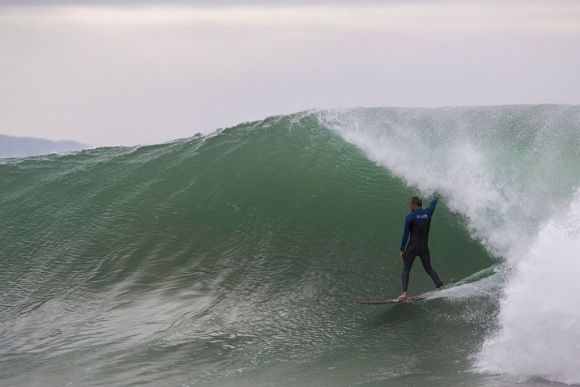
ROOF OF AFRICA: Dylan Stone is a master in big Supers, JBay. Photo Patrick Flanagan
What advice would you give groms, with your knowledge of pro surfing?
The days of the surfing rock star is over. So work hard on your game plan, that is - preparation, fitness, wave catching, equipment, mental toughness and technique and believe in your ability when you put on the vest.
How do you feel about all the surfing ‘stunts’ like a motorbike at Chopes, a SUP at Dungeons, using a flare to surf at night, setting yourself on fire at Chopes?
Online editors and brand managers are constantly looking for new angles to feed the beast that is social media. The 2-3 minute video clip is the media king right now. While I look out for magic clips of cutting edge surfing, some of the surf portals like Surf Europe and Beach Grit to a lesser extent are like red top newspapers looking for sensationalism. It’s pretty harmless but takes up too much space at times.
Surfing is surfing though. The more things change the more they stay the same.
Totally agree. Surfing is primarily not a team sport. So there’s a lot of banter that can spill over into being malicious. That always been there and doesn’t help. The adulation that exists for hot surfers is another common theme. The middle ground is filled with the same wonderment that a new board and a good turn will bring. That’s healthy. In Durban, autumn and winter approach and that means early morning sojourns on north and south and that stoke will always be there.