


Mammalian Dive What?
Tuesday 5 October 2010 Chris Mason chats to Mike Schlebach about the effect of the breath-hold training on SA big wave surfing, and asks Hanli Prinsloo what the Mammalian Dive Response really is. Pics by Annelie Pompe and Jacques de Vos.
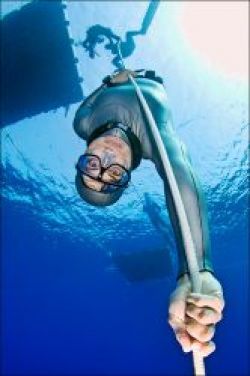
Surfing necessitates holding your breath. The average surfer will surely get a few nasty beatings in their lifetime, but probably won’t ever be submerged for longer than 30 seconds. But for big wave surfers pushing the limits of what is ridable, hold downs of a minute or longer are a reality. So how do they do it? Well, sitting next to me at the recent Cape Chargers event was a clue as to how much the big wave surfers know about holding their breaths, and her name was Hanli Prinsloo.
Although the big wave surfers have been doing their thing way before Hanli came onto the scene, I wanted to know if her training with them in recent years has had an effect on how they react to long hold downs and approach breath hold in those situations. First I asked Mike Shlebach, a quiet giant of the big wave crew to answer a few questions for me.
Chris: Hi Mike, you have done a free diving and breath-hold course with Hanli Prinsloo. How was it and did it affect your performance/ confidence and mental approach to big wave riding?
Mike: I did Hanli’s course a few months before last years Mavericks season and in terms of performance and confidence I think it helped me immensely. Just having the knowledge of what your body is capable of and knowing the signs of when you are really in trouble is a huge confidence booster. In the past, if I started convulsing under water I would think that my time is up but now I know that there is still plenty of oxygen left in my body and I’m good for awhile yet. Good thing to know.
Chris: What was the most valuable lesson you learned from her?
Mike: That your body is capable of a lot more than you think!
Chris: Do you think the training she has done with the SA big wave surfers has had anything to do with their charging so hard in recent times?
Mike: I would say that it’s had a very positive effect, especially on confidence levels but at the same time the ous were always gonna go, it’s just now we have a much better understanding of our limits. In a broad sense, yes, I reckon that it’s been part of the reason the guys are giving it so much stick.
Once I had spoken to Mike, it was time to find out the intricacies of what Hanli was teaching the surfers.
Chris: Now you have done some training with the big wave guys around being in compromising positions, being held down and holding your breath. Something you said the other day intrigued me, about the mammalian dive response. Can you tell me a little about that?
Hanli: Something I realised when I started working with the big wave surfers is that they are mentally unbelievably strong, they paddle into things that would scare mere mortals like us away, but I felt like they could do with more knowledge about how their bodies are behind them on this…What I have taught them is to get their minds around what their bodies are capable of. And that is that we have this mammalian dive response, that we have this inner dolphin that becomes awakened when we are held down underwater. This is powerful stuff because if you get held down under a big wave and your mind is going “I’m gonna die!” you know, who are we to say you are wrong. Whereas if your mind is going “I am a perfectly created diving mammal, I can do this.”

C: What are the physical aspects of the mammalian dive response?
Hanli: Well, the mammalian dive response is something that we are all born with. Whether you are born in the Karoo, or in a rice paddy in China or on an island in the Caribbean. No matter where you are born, you are born with the mammalian dive response, and it is a physical adaptation to breath-hold diving that we all have, and that we have somehow forgotten as we have moved onto the land. The first thing that happens is bradycardia, when your face is submerged underwater your heart rate slows down, dramatically, and it does this to conserve oxygen. The second thing that happens is called vasoconstriction, a constriction of the blood vessels, pushing the blood back to the heart, which pushes it to the brain, where it is needed. The third thing that happens that’s applicable (really applicable for surfers) is about the spleen…basically the spleen is a little storage space of red blood cells. Oxygenated red blood cells. When you are free diving, or being held down and your body gets to a certain point when the carbon dioxide is getting high and the body needs to conserve oxygen, the spleen constricts and becomes smaller than half its size, flushing red blood cells into the blood stream. It’s almost like your own little personal blood doping, except it’s legal, and it’s in you. And this is something I have told the guys to keep in their minds because when you are down there you can start going through these things, and start listing them in your head; what your body is doing to help you survive, what your body is doing to take care of you, you won’t even have time to panic before you are let up again... So I have trained the guys in activating the mammalian dive response, and I have given them training exercises to work with to actually develop this.
C: How do you train this?
Hanli: Ah, you’ll have to do the course Chris (laughs). It’s breath holding training where you start getting your body used to carbon dioxide, to get your body to realise that carbon dioxide isn’t an evil and understand what contractions, which is the breathing contraction, when the diaphragm starts constricting, trying to force air into your lungs, what that means. For a lot of people they think that means that they are about to die, and it doesn’t, it has a whole lot of other implications.
C: Finally, do you have any tips for the everyday surfer caught in a compromising hold down position?
Hanli: Don’t panic. Seriously, if you panic you might as well embrace drowning because a panicked mind is what’s going to tell you to open your mouth underwater cause you think you need to breathe. You don’t. Keep your mouth shut at all costs, don’t get water into your lungs, stay relaxed, and know that your body is capable of more than you think.