


Flight of the Eagle
Wednesday 26 June 2013 Shane McConkey burned through life like an incandescent flame until it was extinguished in the Dolomites of Italy during a ski BASE and wingsuit flight. Spike met Shane's widow Sherry, who was flown out for the premiere of his film.
The BASE jumper drops off bridges and cliffs with a parachute. Most people know that.
Wingsuit flyers jump with a parachute wearing artificial wings that enables them to fly, almost literally. Most people get that.
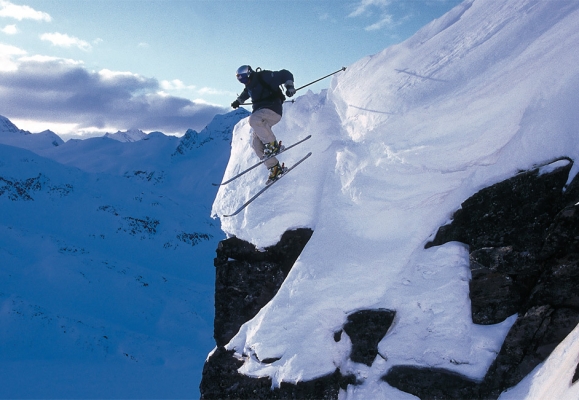
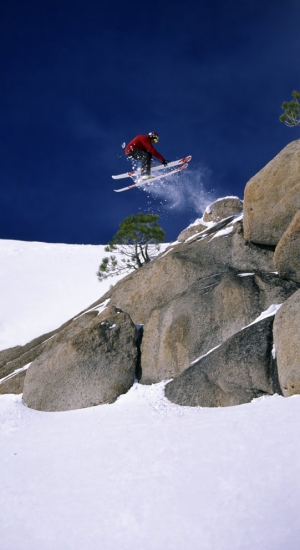
As you move progressively towards the red zone of the insanity continuum, you get the scary combination of a snow skier wearing a wingsuit and a parachute skiing down slopes that end in a cliff. At high speed, just before he hits the lip, so to speak, he sheds his ski poles and leans forward, legs together and arms at his side.
He blasts off the precipice into the vertiginous vacuum. The more daring will perform tricks, such as backflips and somersaults. Then he pulls a Velcro strap that ejects the skis. The madcap tumble in space morphs from ski stunt to winged flight. Soaring at speeds of almost 300 km/h, he follows the contours of the rock face that whip past metres away from his arm outstretched like a surfer might when he wants to drag a hand in the wave he is riding.
Except this is one giant, immovable wave and made of less-forgiving granite or stone. Look but don't touch. A BASE jump may last mere seconds, but the wingsuit can add a minute to your experience, and give you the closest feeling a human being can get to pure flight.
One of the pioneers of this exceedingly dangerous mixture of skiing, wingsuit and BASE jumping was Canadian Shane McConkey.
I met his widow Sherry last week at the premiere of his film at the Wavescape Film Festival called, simply, McConkey. Originally from the South Coast of KwaZulu-Natal, Sherri herself has BASE jumped, rock climbed and mountain biked around the mountains of Lake Tahoe, where she now lives as a single mom with her eight-year-old daughter Ayla.
Red Bull had flown her out especially to attend the premiere. In front of a full house at the Labia, she quietly introduced the film. It took less than 30 seconds. She just said it was special, and she hoped people would enjoy the movie. Her understatement was in stark contrast to the story that followed.
McConkey's adrenaline-fuelled life began with ski racing as a youngster. He was a candidate for the US ski team but narrowly missed out on selection. He almost became a ski bum after the rejection, but soon found that his crazy disregard for personal safety and a penchant for inventing new ski tricks and even ski designs was a way to secure a career.
He starred in a bunch of extreme ski movies, and soon carved a niche as one of the main “go-to” guys for ski stunts.
On a learning curve to find bigger thrills, McConkey had a love of flight. He became a veteran sky diver, and in late 1996, working with BASE pioneer Frank Gambalie, did his first BASE jump. However, in 1999, Gambalie drowned trying to cross a river as he ran away from park rangers in Yosemite National Park. It was an anti-climactic way to go after successfully pulling of a BASE jump off the infamous El Capitan, an illegal act.
For 10 years McConkey steadily worked his way through the many terrifying types of jumps that comprise the acronym: Buildings, Antennae, Span (bridges) and Earth (cliffs and rockfaces).
However, the game-changing moment in his trajectory came after he saw a sequence in the James Bond film The Spy Who Loved Me from 1977, in which stunt skier Rick Sylvester (Bond being chased by gun-toting baddies) skis off Mount Asgard in Canada before deploying his parachute. The wingsuit came into the picture some time in 2004 when they looked to push through to a new level by adding a way to finish off the fall with flight.
In the words of Tim Sohn, in a great article for Outside magazine:
"In February 2007, on a 3,000-foot cliff in Norway, McConkey and (his friend JT) Holmes each performed three successful wingsuit ski-BASE jumps, in which they skied off the cliff, released their skis, and flew for about 40 seconds before opening their parachutes. It was the first time such a stunt had ever been attempted."
{youtube}qw77HagbeHM{/youtube}
The new combination enabled McConkey and Holmes to ski in some of the most inhospitable mountains of the world, riding lines that were previously deemed impossible. They conquered the 3,600 foot vertical face of the Troll’s Wall in Norway, and the Eiger Mountain McConkey ended up repeating Sylvester’s ski BASE jump off Mount Asgard. His signature move was to ski off the cliff, do a double back flip, before turning the move into a BASE jump, followed by a wingsuit glide and parachute. But the complexity of the combination of three different sets of parameters and equipment created concern.
A meticulous planner, McConkey was thorough and precise when preparing for a flight, but the inevitable loomed.
On March 26, 2009, McConkey died in the Dolomite Mountains of Italy. He pulled off a double back flip but instead of gliding away from the cliffs in his wingsuit, he went into a spin. His left ski failed to disengage, and the right ski got caught. He free-fell for 12 seconds as he tried to get the skis off.
When he did, it was too late.