


Eddie Comes to ZA
Wednesday 25 November 2015 As Hawaii prepares for an #EddieWouldGo day, the spirit of Eddie Aikau comes to South Africa in the form of a traditional voyaging canoe. Hawaiian Journalist Derek Ferrar tells an amazing story.
{youtube}LcMvYE9d2F8{/youtube}
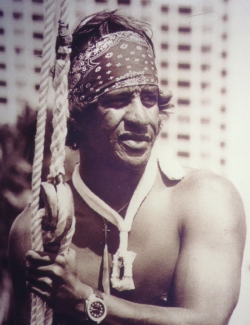
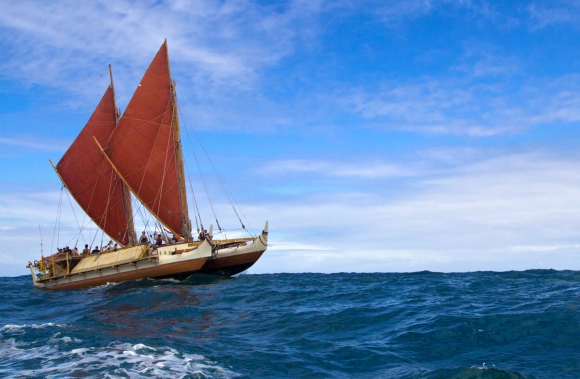
Today, the Polynesian Voyaging Society boat Hōkūleʻa brings some aloha spirit to Cape Town and in particular the spirit of Eddie Aikau as it returns to a country with deep meaning for him, the place where he met two special families.
It is interesting to note that the legendary Hawaiian surfer and lifeguard gave his life trying to paddle for help when the same boat Hōkūleʻa capsized off Moloka‘i in 1978. The boat is a project by the Polynesian Voyaging Society and has been sailing for 40 years. The current Mālama Honua Worldwide Voyage is a four-year 60,000 nautical mile journey around the world. Mālama Honua means “to care for the Earth. The voyage aims to reconnect peoples around the world to care for our planet.
In 1972, Eddie was invited to compete in the prestigious Gunston 500 surf competition in Durban, his first trip abroad. But from the beginning, there were concerns that Eddie might run into trouble in a country living under the yoke of apartheid, the brutal system of official racial segregation. Even prime beaches were reserved for whites only.
And indeed, when Eddie arrived shortly before the competition began and tried to check into the hotel where all the other contestants were staying, he was stopped by security in the lobby and promptly escorted out. “He didn't even have a chance to tell them, ‘Hey, I’m Hawaiian,’ ” recounts Eddie’s brother Clyde in the recent ESPN documentary Hawaiian: The Legend of Eddie Aikau.
“But it didn't matter at that time; if you were black, you were out. And Eddie was literally on his own in a foreign country that he’d never been to before, and labelled black.”
Eddie told Honolulu Star-Bulletin writer Pierre Bowman after he returned home that he had even been in a quandary over which segregated restroom to use. “I just didn’t know where to go,” he said. Finally he decided to use the washroom labeled 'European,’ which caused a huge stir, “but nobody chased me out.” One of the things that stung the most, he said, was that none of the white competitors who also came from Hawai‘i for the contest even bothered to check on how he was doing.
“I was all on my own there,” he told Bowman. “During the day, nobody from home ever asked ‘Where are you going? Is somebody taking you around?’ They forgot me, man.”
Fortunately, Eddie was rescued by the father of future South African surfing great Shaun Tomson, who was just a teenager at the time. After Eddie was booted from the hotel for being too dark, Tomson recalls, “my dad and I picked him up. We were staying in a small, private hotel because we had just had a house fire, and he came and stayed with us. I was still at school, but we’d hit the dawn patrol, and my dad took care of him.”
Eddie made it through the first day of the three-day contest, but was eliminated on the second day. However, his air ticket required him to stay in South Africa for at least 10 days. In the meantime, the Tomsons had introduced him to Australian surfboard shaper Darryl Holmes and his wife Lynne, who were living in Durban.
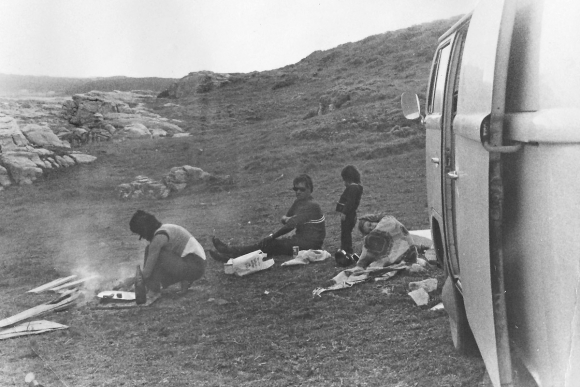
The Holmes family threw a party for Eddie, and after he was out of the contest, they loaded him and their two daughters into their VW “Kombi” van and took a 600-mile road trip south to the legendary surf break Jeffrey’s Bay. “We surfed our guts out,” Eddie recalled later. “People invited us to dinner. I took along a guitar, and it was a big success. I showed them slack key and played the kind of songs we sing here in Hawai‘i.”
“I think Eddie’s experience showed him that there was a lot of love for him in South Africa and that not everyone supported apartheid,” Tomson says. “My dad was deeply troubled when Eddie wasn’t allowed in the hotel.” He notes that after his father was attacked by a shark in Durban in 1946 and traveled to San Francisco for arm surgery, he went to Honolulu to recuperate and while there spent time with Duke Kahanamoku’s family: “I think that after experiencing their aloha he was determined to do the same for Eddie.”
After Eddie met up with the Tomson and the Holmes families, Shaun says, “he only got aloha and good vibes from us and other surfers. Our three families are eternally connected through this, and that’s why I think he always had such a soft spot for South Africans and Australians.”
One of the Holmes’ daughters, Jodi Wilmott – now the general manager of the World Surf League pro tour and executive director of the North Shore’s premier Vans Triple Crown contest series – says, “The focus of Eddie’s story in South Africa has always been cast in a shadow of racism. But what if the situation of Apartheid in Eddie’s case was actually a catalyst that created true friendships that would span a lifetime?
One of the Holmes’ daughters, Jodi Wilmott – now the general manager of the World Surf League pro tour and executive director of the North Shore’s premier Vans Triple Crown contest series – says, “The focus of Eddie’s story in South Africa has always been cast in a shadow of racism. But what if the situation of Apartheid in Eddie’s case was actually a catalyst that created true friendships that would span a lifetime?
My family ended up following Eddie soon after to stay with him and his family. For me, Hawai‘i always felt like home because the Aikaus were here, and that set my life’s path. I have the life, family and career I do because of how we were all brought together by that time in South Africa.”
Eddie’s voice was heard once more aboard Hōkūleʻa a few weeks ago in Durban as the crew listened to this recording of a song he wrote for the Holmes family and sent to them using a small recorder that Jodi’s mom had given him (the song had never been heard publically before).
{mp3}holmes{/mp3}
“Long time ago, in South Africa, met this family,” Eddie sings. “Oh, I was lost, and had no place to go. They took took me in, and made me their friend, and shared their love with me. … They came to my islands and lived with us, met my family, yes they did … and fun was had by all of us. … So God please take care of all the Holmes family.”
Jodi reflects: “Out of the adversity that Apartheid presented at that time, racial boundaries were actually dissolved and a very powerful and wonderful three-family bond was created, that has since touched the various generations and lives of our families … a thread that Eddie wove and continues to weave in our lives today. I believe it’s a story that does exactly what the Worldwide Voyage is trying to accomplish, as Nainoa explained it to me once: 'sewing a thread around the world’ that ultimately ties us all together as one human race on Island Earth.”
Please help keep us sailing for future generations. All contributions at www.Hokulea.com make a difference for our voyage. Mahalo nui loa!
This piece by Derek Ferrar, Hana Hou! Magazine, originally appeared in the crew blog for the Hawaiian voyaging canoe Hokuleʻa’s World Wide Voyage at www.Hokulea.com.